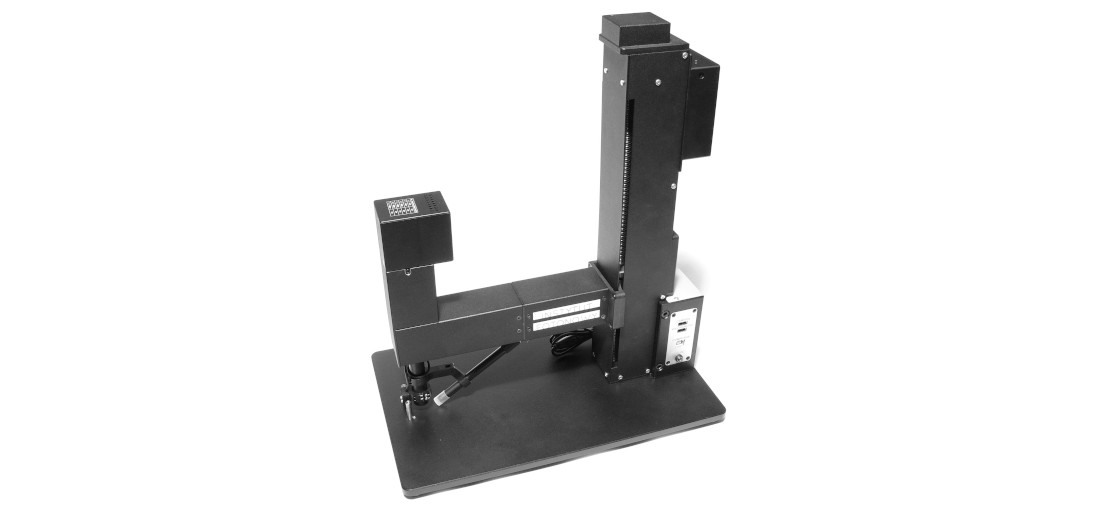


The Micro Fading Tester (MFT) measures temporal behavior of dyes under irradiation.
MFT tests allow to rank objects in collections by their sensitivity to light.
This approach allows to adopt exhibition policies to
actual data obtained for each tested object rather than use
general assumptions which could be either too conservative
and unnecessarily limit viewers access to the object or too optimistic
and lead to irreversible light-induced damages.
The scientific grade instrument is equipped with up to 6 ultra precise LEDs on a motorized holder. One can perform light aging of samples with UV, Vis or NIR LED source and assess the color change with a white LED.
Some users opt for several white LED with different color temperatures, so they can match them to those used in galleries.
Our light calibrator is a mandatory accessory for automatic calibration of light-sources of the MFT.
The MFT allows to measure color change under illumination in a non-destructive way:
(1) the spot of light on a sample has only 0.5 mm in diameter, (2) the total color change (∆E)
for the selected point is constantly monitored during the measurement and the operator
and/or the instrument software could stop the test when ∆E reaches a selected threshold value
(i.e. below reaching the level of just noticeable difference).
In practice, for non-glossy objects fading marks are never visible unless fading was performed
to reach extreme ∆E values (>15).
The micro fading tests could be performed for nearly all classes of materials found in
museum collections, and is particularly suited to study fugitive objects (works on paper –
manuscripts, prints, watercolors; canvas paintings; textiles). Some classes of objects cannot
be tested by the MFT method or their testing is difficult to perform or to interpret obtained
results – objects of a very high light stability and objects interacting with light in an non-typi-
cal manner (highly reflective or transparent). The MFT instrument can be regarded as
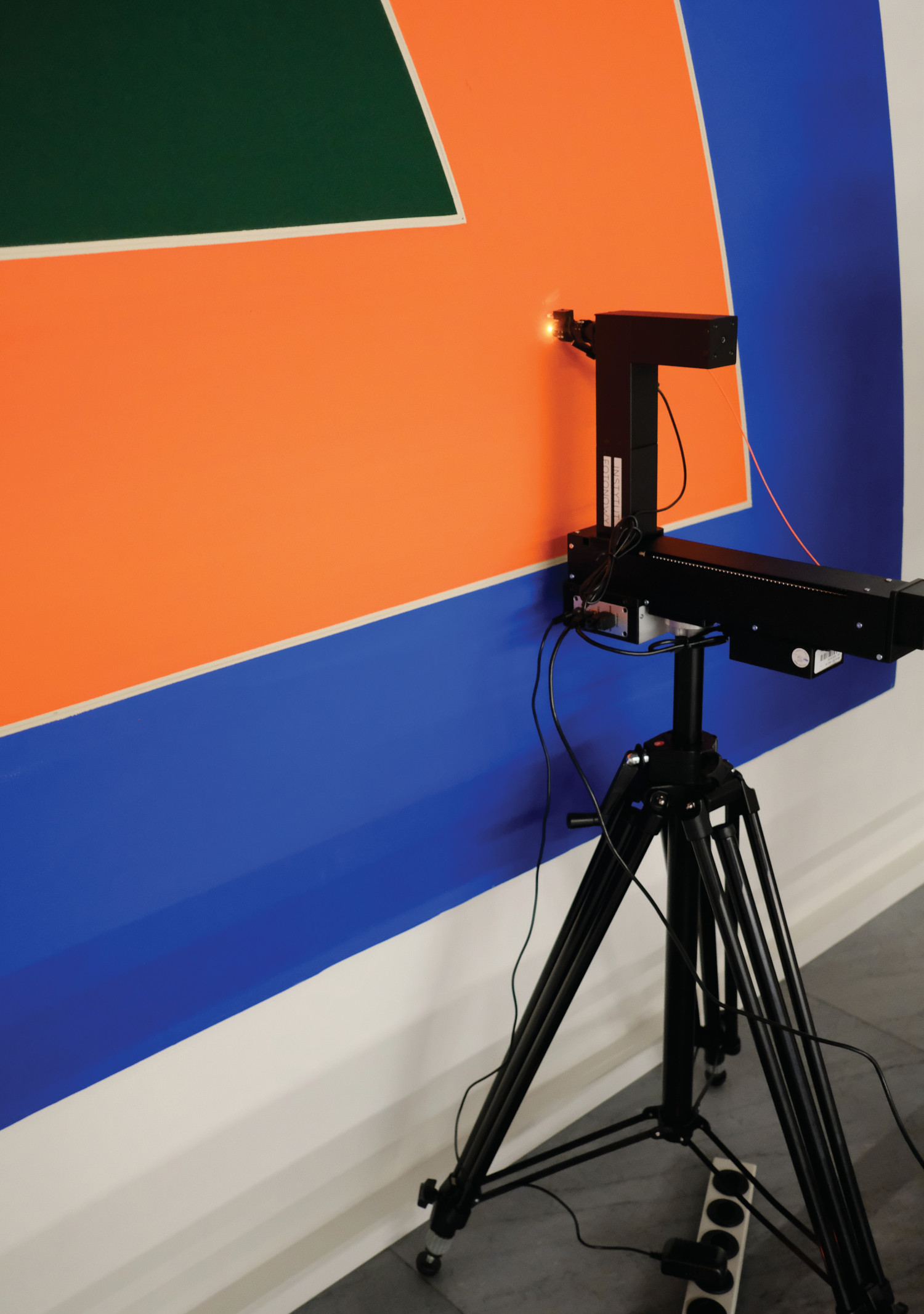
portable and so it can be moved within the museum to the objects’ location,
which is particularly important in case of large artefacts (e.g. wall paintings, sculptures, maps)
or objects of significant value.
The instrument is equipped with the standard tripod holding. It allows to mount the instrument in vertical position to examine large objects that cannot be transported (walls, frescoes, sculptures, etc.)
click the photo to enlarge
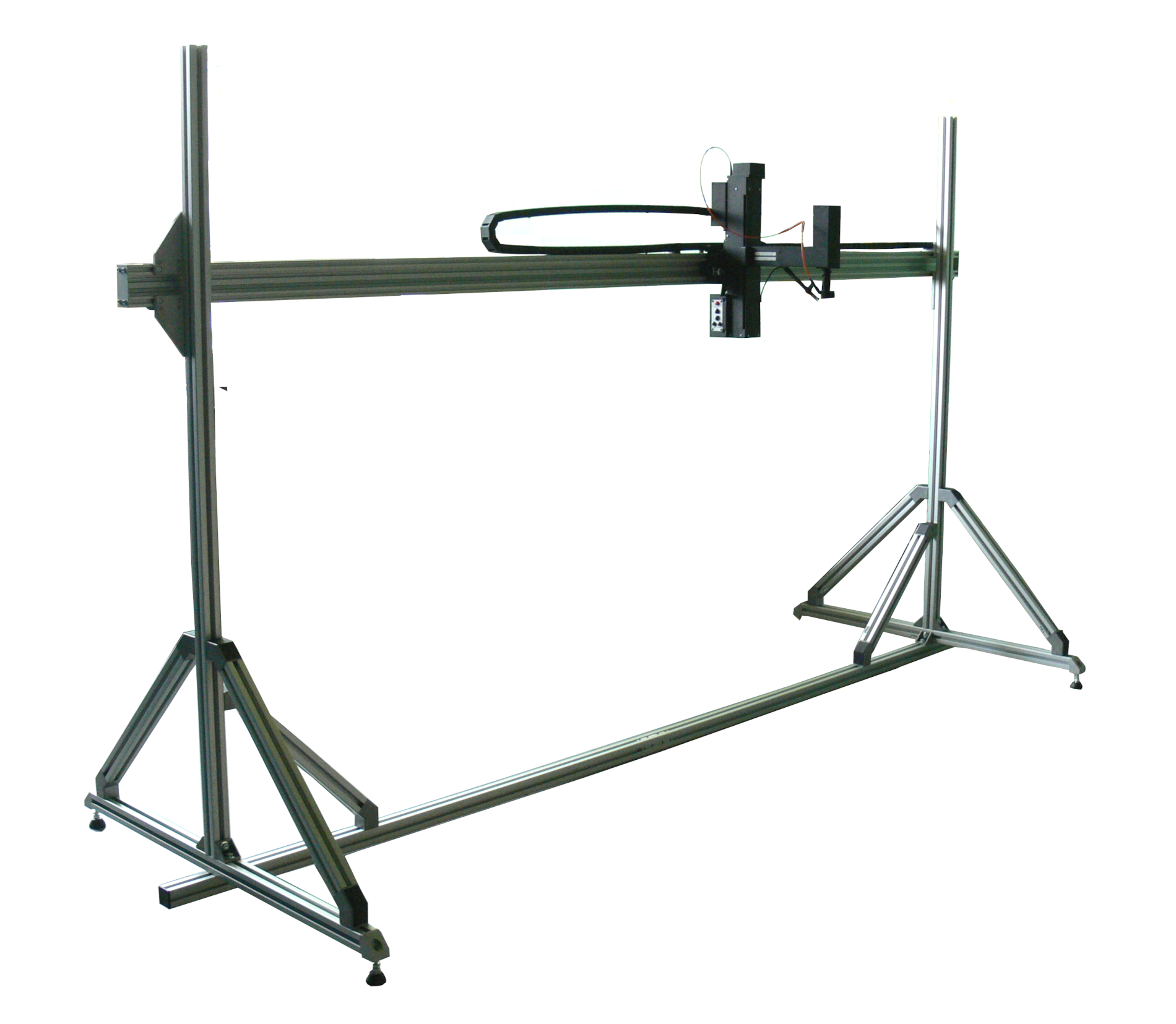
The Micro Fading Tester may be installed on a stand with sliding fixing. This fixing provides stable placement of the instrument above the examined object and enables its smooth movement. The presented solution is particularly helpful for examining:
objects such as tapestries, arrases, posters, or any other large works of art laying on a tabletop.
微褪色测试仪 (MFT) 可测量染料在辐照下的时间行为。
通过 MFT 测试,可以根据藏品对光的敏感度对其进行排序。
这种方法可以根据
而不是使用一般的假设。
一般假设,因为这种假设可能过于保守
或者过于乐观,导致不可逆转的光致变色。
导致不可逆转的光害。
这款科学级仪器在电动支架上配备了多达 6 个超精密 LED。可以使用紫外线、可见光或近红外 LED 光源对样品进行光老化处理,并使用白光 LED 评估颜色变化。
有些用户会选择多个不同色温的白光 LED,以便与画廊中使用的 LED 相匹配。
我们的光校准器是自动校准 MFT 光源的必备附件。
MFT 可以无损地测量照明下的颜色变化:
(1) 样品上的光点直径仅为 0.5 毫米,(2) 在测量过程中不断监测选定点的总颜色变化 (∆E)
(2) 在测量过程中,选定点的总颜色变化(ΔE
和/或仪器软件可以在 ∆E 达到选定的临界值(即低于临界值)时停止测试。
(操作员和/或仪器软件可以在 ∆E 达到选定的临界值时停止测试(即低于仅有明显差异的水平)。
在实践中,对于非光滑的物体,褪色痕迹是永远不可见的,除非进行褪色时
达到极限 ∆E 值(>15)。
微褪色测试适用于博物馆藏品中几乎所有类别的材料。
微褪色测试可对博物馆藏品中几乎所有类别的材料进行测试,尤其适用于研究易褪色物品(纸质作品–手稿、版画、水彩画;布面绘画;纺织品)。
手稿、版画、水彩画;油画;纺织品)。某些类别的物品无法
有些物品无法用 MFT 方法进行测试,或者很难进行测试或解释测试结果。
光稳定性极高的物体和以非典型方式与光相互作用的物体(高反射或透明)。
物体(高反射或透明)。MFT 仪器可被视为
便携式,因此可以在博物馆内移动到物体所在位置、
这对于大型文物(如壁画、雕塑、地图)或具有重要价值的物品尤为重要。
或具有重要价值的文物。