

你可能听说过量子世界很奇怪,甚至更糟的是,量子力学(QM)是如此不自然,以至于没有人真正理解它。好吧,自己判断吧。如果你阅读完这个笔记后仍然觉得这一切都是魔法,那就自罚一下,从我们的竞争对手那里购买吧。
对于量子力学内部运作的最被滥用的例子之一就是薛定谔的猫“悖论”。这个想法是将一个小的量子对象放大到与一只大动物相同的尺寸,以演示它的奇怪行为。实验设置如下:一个放射性原子放置在一个装有一只活猫的盒子中。如果原子衰变了——这是放射性原子不时会发生的事情——那么猫就会死。如果它没有衰变,猫就存活。
将QM的规则应用于原子和猫表明,在一段时间后,原子处于所谓的叠加态:既衰变又不衰变,同时发生。所以猫也处于叠加态:死和活。
叠加态意味着如果你有,比如说,1000个经过相同准备的放射性原子,并检查它们是否衰变,你会发现其中一些确实衰变了,一些没有,而另一些无法确定。如果类似的推理应用于比如说1000只猫,相同比例的动物应该是死的、活的或无法确定的。
然而,这里有个问题。从来没有人见过“无法确定”的猫,即既死又活的状况。
另一方面,没有理由认为QM的规则应该适用于一个原子而不适用于由原子组成的猫,毕竟猫也是由原子构成的。
我们的日常经验是否与被检验最多的物理理论相矛盾呢?如果是这样,哪一个是正确的?亚里士多德曾经说过矛盾是不存在的。嗯,他既死了,同时又是对的。
这个谜题的解决方案是:一个人可以拥有无法确定的放射性原子。猫由许多原子组成,每个原子都遵循QM的规则。因为形成一只猫需要如此多的原子,所以没有无法确定的猫。
这里有一个简单的解释。
一个原子
看一下图1的上图,它描述了对一个原子进行位置测量可能的结果,该原子已经准备在左侧的状态(以-1为中心)和右侧的状态(以2为中心)之间的叠加。如果原子出现在位置-2,那么它肯定来自左侧状态。如果它在位置3,那么右侧状态就是起源。这两个状态的中心之间的距离为3,大于这两个状态的宽度。
要在位置0.5的附近找到一个“未决定”的原子,需要对这些原子进行成千上万次的逐一测量。因此,我们可以说这样的事件是不太可能发生的。
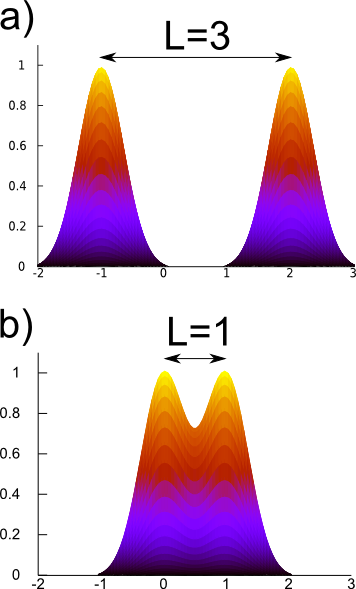
图1. a) 两个状态的叠加中的一个原子:左侧和右侧。没有未决定的区域。在测量中发现在-1附近的原子来自左侧状态。在2附近找到的原子来自右侧状态。b) 两个状态的叠加中的一个原子,有很大的未决定区域。无法确定在1附近找到的原子是来自左侧还是右侧状态。
在图1b中展示了一个不同的情景。在这里,一个原子处于重叠的左侧和右侧状态的叠加中。因此,发现它在位置,比如说0,并不能揭示它的起源。这是我们对“未决定”原子的模型。
我将使用更多的原子,同时都处于左侧状态和右侧状态,来模拟薛定谔的猫。
许多原子
在量子力学中,每增加一个原子就会带来一个新的维度。如果考虑一个原子,其可能的位置如图2a的一维图中所示。两个原子,都像图2a中的那一个,需要二维图,如图2b所示。在这里,状态之间的分离更加明显。对于三个这样的原子,需要三维图,依此类推。一个典型的猫由超过1025(或10,000,000,000,000,000,000,000,000)个原子组成。
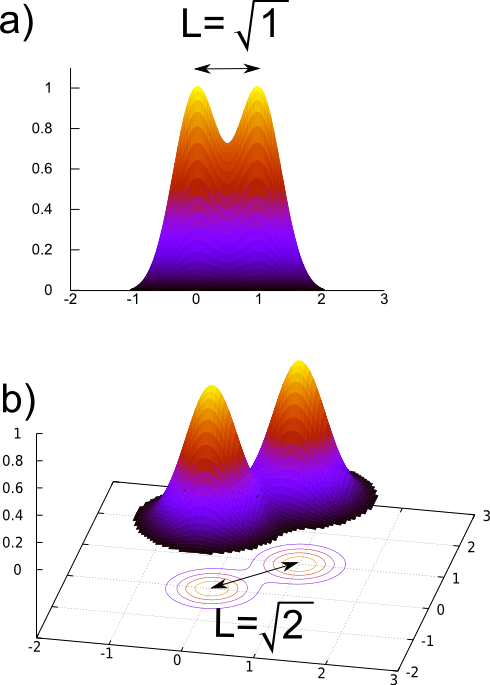
图2. a) 处于左侧和右侧状态叠加中的一个原子。b) 两个处于左侧和右侧状态叠加中的相同原子。
关键观察
单个原子源自左侧或右侧状态,分别位于0和1位置。状态的宽度与它们在一维空间中的距离相当,因此它们是重叠的。
如果考虑N个原子,左侧和右侧之间的距离变为√N,而它们的宽度保持不变。因此,对于多原子的猫:所有处于左侧状态的原子和同时所有处于右侧状态的原子,相应的多维图形将由两个完全分开的部分组成,按照任何实验标准。这就是为什么对猫的测量能够毫无疑问地揭示其起源,即左侧(死亡)或右侧(活着)状态。
可以说,由于几何原因,多原子空间的维度解决了这个悖论。
对于专业人士: 在这里,我只考虑了玻色型的薛定谔猫:两个略微偏移的凝聚体的叠加。对于费米型的薛定谔猫,论证是相同的。即使在质心(在3D中)发生微小偏移,对应于死亡和活着的猫,也会导致两个完全分离的多维概率分布。
Zbigniew Karkuszewski, 2009 年 2 月 22 日
You may have heard that quantum world is weird or even worse, that quantum mechanics (QM) is so unnatural that no one really understands it. Well, judge for yourself. If you read this note through and still think it’s all magic, punish yourself by buying from our competition.
The most abused example of inner workings of QM is the Schrödinger’s cat “paradox”. The idea is to magnify a small quantum object to a size of a big animal in order to demonstrate how strangely it behaves. The setup is the following: A radioactive atom is placed in a box with an alive cat. If the atom decays, this is what radioactive atoms do from time to time, the cat dies. If it doesn’t decay, the cat survives.
Applying rules of QM to the atom and the cat shows that after a while the atom is in, so called, superposition: decayed and not decayed, at the same time. So is the cat in superposition: of dead and alive.
The superposition means that if you had, say, 1000 identically prepared radioactive atoms and you check whether they decayed or not, you would find out that some of them did decay, some did not, while the rest could not be decided either way. If similar reasoning is applied to, say, 1000 cats the same fraction of animals should have been dead, alive or undecided.
There is this problem, though. No one have ever seen an “undecided” cat, i.e. both dead and alive.
On the other hand, there is no reason why the rules of QM should apply to an atom and not to cats that are built out of atoms, after all.
Does our everyday experience contradict the most tested theory of physics? If so, which is right? Aristotle used to say that contradictions do not exist.
Well, he is dead and right at the same time.
The solution to the puzzle is this: One can have undecided radioactive atoms. Cats consist of many atoms and each atom follows the rules of QM. Because, it takes so many atoms to form a cat, there are no undecided cats.
Here is a simple explanation.
One atom
Take a look at the upper plot of Fig. 1. It depicts possible outcomes of position measurement on an atom that had been prepared in a superposition of the left, centered around -1, and right state, centered around 2. If the atom happens to show up at position -2 it certainly came from the left state. If it was at position 3, the right state was the origin. The centers of the two states are separated by distance 3, which is larger than the width of the two states.
To have a chance of finding an “undecided” atom in the vicinity of the position 0.5, one would have to perform thousands of measurements on such atoms, one by one. Thus we can say that such an event is improbable.
Fig. 1. a) An atom in superposition of two states: left and right. No undecided region. The atom found during measurement around -1 comes from the left state. The atom found around 2 comes from the right state. b) An atom in superposition of two states with large undecided region. One cannot tell whether the atom found around 1 came from the left or the right state.
A different picture is shown in the Fig. 1b. Here, an atom is in a superposition of overlapping left and right states. Thus finding it at the position, say 0, doesn’t reveal its origin. This is our model of an “undecided” atom.
I will use more atoms, all in the left state and all in the right state, at the same time, to model a Schrödinger’s cat.
Many atoms
In QM each additional atom brings a new dimension with it. If one atom is considered, its possible positions are depicted in the one dimensional plot of the Fig. 2a. Two atoms, both like the one in Fig. 2a. require two dimensional plot as in the Fig. 2b. Here the separation between states is more convincing. For three such atoms — three dimensional plot are in order, and so on. A typical cat consists of more than 1025 (or 10,000,000,000,000,000,000,000,000) atoms.
Fig. 2. a) One atom in the superposition of states left and right. b) Two identical atoms in superposition left and right.
Crucial observation
A single atom originates from the left or the right state centered at 0 and 1 positions, respectively. The width of the states is comparable with their distance in 1D, so the states overlap.
If we consider N atoms, the distance between left and right becomes √N, while their width remains unchanged. Thus, for the multi-atom cat: all atoms in the left and, simultaneously, all atoms in the right state, the corresponding multidimensional plot would consists of two perfectly well, by any experimental standards, separated parts. This is why, a measurement of a cat reveals the origin, the left (dead) or the right (alive) state, beyond any doubt.
One can say that there are no undecided cats for geometrical reasons. Shear dimensionality of the multi-atom space solves the paradox.
For professionals: Here I considered only a bosonic Schrödinger’s cat: superposition of two slightly displaced condensates. The argument for a fermionic one is the same. Even a tiny displacement of the center of mass (in 3D), corresponding to dead and alive cat, results in two completely separated multidimensional probability distributions.
Zbigniew Karkuszewski, February 22-nd 2009