

在经典光学中,为了缩小来自广泛光源的光束宽度,使用聚焦透镜和针孔。这种设置会导致光强的大量损失,并且使用更多透镜、镜子和屏幕也无法改善。
然而,在非线性光学的帮助下,有望突破这种限制。如果光在传播过程中改变了材料系统的光学特性,那么光束本身也可以被修改。这可以增强一系列有趣且意想不到的观察和应用过程[1]。在第一台激光器创建后不久,就报告了激光束自发形成空间结构的现象。自聚焦和自囚禁光的过程已经在不同媒介中进行了研究,如光折变晶体、液晶或半导体材料,甚至在冷原子蒸气中也进行了研究。
尽管已知冷原子是测试理论模型的有用工具,是我们唯一一次窥视由量子法则统治的世界的机会,就像科幻场景中的那样,但迄今为止并没有实际应用它们的方式。但未来可能并非如此。也许在未来,它们实际上可以成为从广泛光源中整理光的传统方式的替代方法。
为什么呢?为了回答这个问题,让我们更仔细地看一看在法国尼斯非线性研究所进行的实验结果[2]。在实验中,一团冷Rb85原子云已经被制备在一个磁光陷阱中,选择了两个超精细能级F=3和F=4之间的谐振激发的单一跃迁。激发负责介质的饱和。实验设置的简化方案如图1所示。
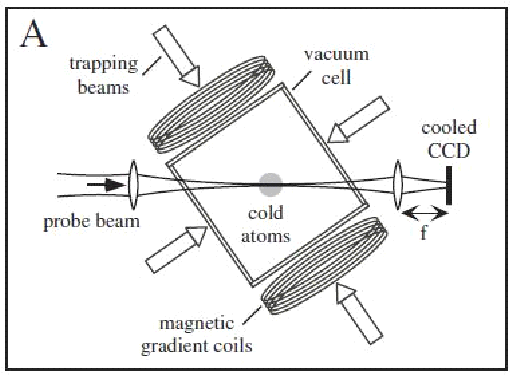
图1显示了蒸汽池以及用于捕获的激光束(在图像垂直方向上看不到的另外两束),允许将云定位在陷阱中心的磁线圈,以及穿过的探测光束。
在原子样品与激光束之间的相互作用结果中,对于饱和参数的足够高的值,激光束强度在零横向波矢分量上增加。饱和参数定义为 s(x,y)=I(x,y)/I_sat, 其中 I(x, y) 是激光束的初始强度,而 I_sat 是饱和强度。在铷原子的实验中,I_sat=1.6mW/cm2。
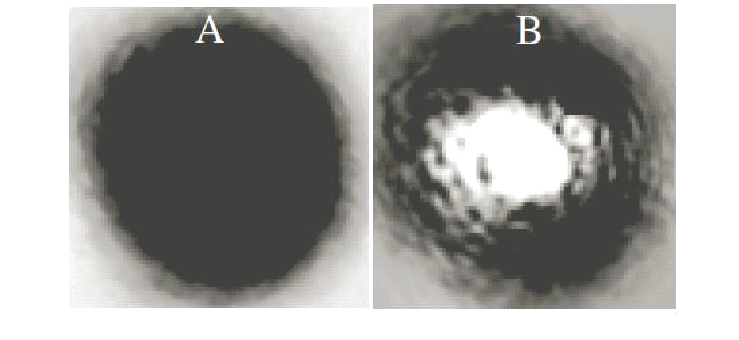
图2显示了激光束(使用CCD摄像机拍摄的图像)在通过腔体后的强度分布的比较(原子密度分布的图像已删除)。灰度表示激光束强度的数值;白色表示较大的强度数值。对于参数 s=1340(B),其值比 s=50(A)高25%。
对于光束的整流,最重要的是减小与光传播方向不平行的模式的强度。图3显示了通过装有原子的蒸汽池的光束中这些模式是如何受限的。
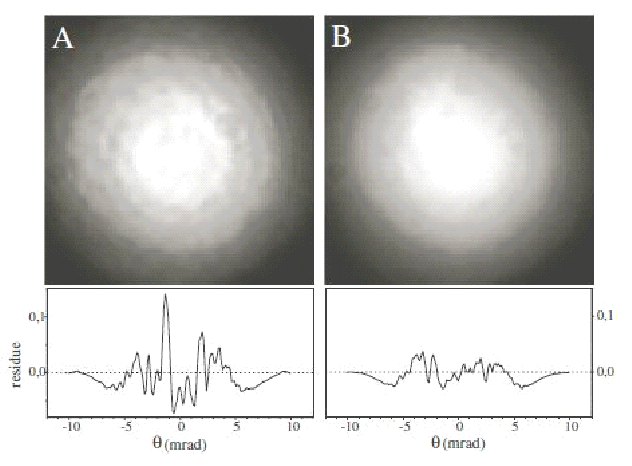
图3显示了光束在通过没有任何原子的蒸汽池(A)和有原子存在时(B)的传播后的强度分布。顶部图片由CCD相机拍摄,底部是通过光束中心的垂直轴的截面。它显示了与高斯轮廓的偏差。当蒸汽池装有原子时,波动的RMS值减小了3.5倍。
该实验的结果表明,光束在经过冷原子后可以实现低强度的准直。使用原子探测来确定介质如何响应光的巨大优势在于,这一现象可以用一个简单的理论模型来描述,并且介质中的波动被消除。在晶体或半导体等样品中,波动可能会损坏样品。
有趣的是,存在不同类型的非线性,可以帮助实现比所示更低的入射光强度的光束聚焦。而且,原子不必冷却到极低的温度。室温下的原子也可以作为方便的非线性介质。它们在技术上更容易使用,非线性相当容易理解,但在考虑到多普勒展宽和与必须考虑的速度类别的相互作用方面存在一些复杂性。这是一个只能通过降低原子样品的非线性系数的代价来消除的障碍。
然而,创建磁光陷阱(MOT)仍然是一个困难而且要求高的过程。该系统仍然相当复杂、昂贵,并且需要一个整个团队的人来支持和操作。
即使实验设置的微型化和简化似乎难以克服,也许这一次需求将是发明之母。
参考文献:
1. R. Boyd, Nonlinear optics, Academic Press, 1992.
2. G. Labeyrie, T. Ackemann, B. Klappauf, M. Pesch, G-L Lippi, R. Kaiser Eur. Phys.J. D 22, 473 (2003)
Katarzyna Targońska, 2010 年 12 月 1 日
In classical optics, in order to narrow the width of the light beam comming up from an extensive source, a focus lense and a pinhole is used. That type of setting produces great losses in the intensity of the light and there is no improvement that can be achieved with use of more lenses, mirrors and screens.
However, with the help of nonlinear optics there is hope to go beyond the limitation. If the light changes the optical properties of a material system during its propagation, than the beam itself can be modified, too. That can enhance a whole spectrum of interesting and unexpected processes that can be observed and used [1]. Shortly after the creation of the first laser, a spontaneous formation of spatial structure of a laser beam, has been reported. The processes of self-focusing and self-trapping of light have been explored in different media such as photorefractive crystals, liquid crystals or semiconducting materials and also … in the cold atoms vapors.
Despide the fact that cold atoms are known to be useful tool for testing theoretical models, to be our only chance to obtain a glimpse of the world that is governed by quantum laws much like those from science fiction scenerios, there has been no practical use of them whatsoever. But it doesn’t have to be this way. Maybe, in future, they actually can become an alternative for traditional way of collimating light from extensive sources.
Why? In order to answer this question lets take a closser look into the result of the experiment that was performed in Institut Non Linéaire de Nice in France [2]. In the experiment, a cloud of cold Rb85 atoms has been prepared in a magneto-optical trap and a single transition of resonant excitation between two hyperfine levels F=3 and F=4 has been selected. The excitation is responsible for the saturation of the medium. The simplified scheme of the experimental set up is presented in Fig. 1.
Fig. 1 shows the vapor cell together with the trapping laser beams (two additional not seen are in the direction perpendicular to the picture), the magnetic coils that allow to localize the cloud in the center of the trap, and the passing probe beam.
The results of the interaction between the atom sample and the laser beam are reflected in an increase of the laser beam intensity in the zero transverse wave vector compontent for high enough values of the saturation parameter, defined as s(x,y)=I(x,y)/I_sat, where the I(x,y) is the initial intensity of the beam, and I_sat is the saturation intensity. In the experiment with the Rubidium atoms I_sat=1.6mW/cm2.
Fig. 2. A comparision between the intensity distribution for the beam (the picture is taken with CCD camera) after the propagation through the cell (the image of the density distribution of the atom has been removed). The grey scale stands for values of the beam intensity; white color means large values of intensity. The is 25% higher for parameter s=1340 (B) then for s=50 (A).
For the collimation of the beam, the most important is the reduction of intensity of modes that are not parallel to the direction in which the light propagates . In the Figure 3, it is shown that those modes are limited in the beam that has passed through the vapor cell loaded with atoms.
Fig. 3. The distriubtion of the intensity of the beam after the propagation through the cell without any atoms in it (A) and with the atoms present (B). The top pictures are taken by the CCD camera, the bottom part is a cross-section along a perpendicular axis passing through the beam center. It shows the deviation from a Gaussian profile. The RMS value for fluctuations is reduced by the factor of 3.5 when the vapor cell is loaded with atoms.
The results of the experiment show that the beam can be collimated after passing through the cold atoms with relatively low intensities. The great advantage of using atom probes to determine how the medium responds to the light is that the phenomenon is decribable by a simple theoretical model, and fluctuations in the medium are eliminated. The fluctuations can demage the sample in case of, for exemple, crystals or semiconductors.
It is interesting, that there exist different types of nonlinearities that can help to focus a beam with even lower intensities of an incident light than were presented. Moreover, the atoms do not have to be cooled down to extremely low temperatures. Atoms in room temperature, can serve as a convenient nonlinear medium, as well. They are technologically easier to use, the nonlinearity is fairly easy and understood, but there are complications with respect to a Doppler broadening and an interaction with different classes of velocity that have to be taken into account. It is an obstacle that can be removed only at cost of lower value of nolinearity coefficient for atomic sample.
However, the creation of the magneto-optical trap (MOT) is still difficult and demanding proces. The system is still rather complicated, expensive and it demands a whole group of people that has to stand behind and operate it
Even if miniaturization and simplification of the experimental setting seems to be hard to overcome, perhaps also this time the need will be the mother of invention.
References:
1. R. Boyd, Nonlinear optics, Academic Press, 1992.
2. G. Labeyrie, T. Ackemann, B. Klappauf, M. Pesch, G-L Lippi, R. Kaiser Eur. Phys.J. D 22, 473 (2003)
Katarzyna Targońska, December 1-st 2010